

Over 350 clinics nationwide with prime locations open 7 days a week. Find your closest clinic

Do you know how your hearing aids work?

Hearing aids have come a long way in recent years—smaller, smarter, and more powerful than ever before. But how do hearing aids work exactly?

Whether you're considering a device for the first time or simply curious about the technology behind them, this article explains how different types of hearing aids function, including digital, Bluetooth and AI-powered models.

Understanding how hearing aids work

At their core, hearing aids work by amplifying sound and delivering it into your ear. But there’s more going on under the surface.

A standard digital hearing aid has four main components:

  • Microphone – captures sound from the environment
  • Amplifier – increases the strength of the sound
  • Receiver (or speaker) – sends the sound into your ear
  • Battery – powers the entire system

These devices are calibrated based on your hearing test results, ensuring that only the frequencies you struggle to hear are amplified—resulting in a clearer, more natural listening experience.

Come and visit us in an Amplifon clinic.

Book an appointment and come and visit us at one of our Amplifon clinics, our hearing care professionals will be ready to answer any of your curiosities about the world of hearing and to show you our range of Amplifon hearing aids.

What does a hearing aid look like?

Hearing aids are made up of several components that can help improve a person's hearing. What do hearing aids look like in detail? Each device consists of microphones, a computer chip, an amplifier, a receiver and a battery.
The microphone detects sound and turns it into a signal, the amplifier increases the volume and the receiver reproduces the sound by sending it to the ear.

Microphone

The microphone is the first point of contact for sound in a hearing aid. It picks up sounds from your surroundings—such as speech, traffic, or birdsong—and converts them into electrical signals that the device can process.
Many modern hearing aids feature directional microphones, which focus on the sounds in front of you to improve speech clarity in noisy settings.

Amplifier

Once the sound is captured, it travels to the amplifier. The amplifier’s job is to make the sound louder, but in a smart way—it boosts specific frequencies based on your hearing test results.
This means you’ll hear the sounds you struggle with most, without making everything overwhelmingly loud.

Speaker

After amplification, the receiver—or speaker—converts the electrical signal back into sound and delivers it into your ear canal. This is what allows you to actually hear the processed and enhanced sounds.
In many devices, the receiver sits in or near the ear for more natural sound delivery.

Battery

Every component of a hearing aid needs power to function, and that’s where the battery comes in. Hearing aids can be powered by disposable zinc-air batteries or built-in rechargeable batteries.
Without this vital component, none of the sound processing would be possible.
Test your hearing ability from the comfort of your home Take the online hearing test

How different types of hearing aids work?

Hearing aids can differ in price, size, technology, placement in the ear and visibility.

The three main models are as follows:

BTE

Behind-the-ear

They pick up sound with a microphone, amplify it inside the device (behind the ear), and deliver it through the tubing into your ear canal. BTE devices are suitable for a wide range of hearing losses and often come with Bluetooth and rechargeable options.

ITE

In-the-ear earmolds

ITE (In-The-Ear) hearing aids sit entirely within the outer ear. They capture sound through a small microphone, amplify it digitally, and deliver it directly into the ear canal via an internal speaker. ITE devices are custom-moulded to fit your ear and are ideal for mild to moderate hearing loss, offering a discreet design and easy handling.

RIC

Receiver-in-the-ear

RIC (Receiver-In-Canal) hearing aids have a behind-the-ear component that houses the microphone and amplifier, while the receiver (or speaker) sits inside the ear canal. A thin wire connects the two parts. RICs provide a natural sound experience, reduce feedback, and are suitable for a wide range of hearing losses—from mild to severe.

How do bone conduction hearing aids work?

These devices bypass the ear canal and middle ear entirely. Instead, they send vibrations through the skull bone directly to the inner ear (cochlea). They’re ideal for people with conductive hearing loss or outer ear malformations.

How do CROS hearing aids work?

CROS hearing aids (Contralateral Routing of Signal) are designed for people that have aidable hearing only in one ear and the other ear has no hearing. They pick up sound from the non-hearing ear using a microphone and wirelessly transmit it to a device worn on the better-hearing ear—helping you hear more evenly from all directions.
An audiologist helping the client wearing a hearing aid at the Amplifon center

Why choose Amplifon?

By choosing Amplifon as your hearing care provider, you’re choosing to be cared and looked after by qualified and experienced Audiologists who can help change the way you listen to the world around you.

Customised hearing aids

Customised hearing aids are designed to fit the unique shape of your ear. Using an impression of your ear canal, the device is moulded to match your exact anatomy—providing a secure, comfortable fit and improved sound delivery.

These hearing aids sit fully or partially inside the ear, making them discreet and easy to wear. Because they’re made specifically for you, they’re less likely to move or cause discomfort during daily activities.

Benefits of customised hearing aids include:

  • A snug, personalised fit
  • Enhanced comfort for long-term wear
  • Reduced feedback and better sound quality
  • A more discreet appearance

Get a free consultation

Discover the benefits of modern connectected hearing aids – book your free trial at Amplifon and experience seamless hearing technology!

Book an appointment
woman holding a hearing aid at Amplifon

Custom styles include ITE (In-The-Ear), ITC (In-The-Canal), CIC (Completely-In-Canal), and IIC (Invisible-In-Canal) models—each offering varying levels of visibility and power.

At Amplifon Australia, our hearing care professionals can help you explore the best custom fit hearing aid options based on your hearing profile and lifestyle needs.

Hearing aid or cochlear implant?

Compared to a hearing aid, which is removable at any time, a cochlear implant is an electronic device that can only be fitted through surgery, inside the cochlea.
Its purpose is to directly stimulate the auditory nerve so that sounds can be perceived. It is recommended when hearing aids are no longer sufficient.

Fitting and adjustment of hearing aids

Wearing hearing aids for the first time can be quite tedious for some people. The fitting and adjustment of hearing aids require the intervention of a professional: the audiologist, an expert whom the proper functioning of the devices depends on. When the question of how to adjust hearing aids arises, the hearing care professional is the correct person to turn to.
Find your nearest Amplifon clinic Request an appointment

How do AI hearing aids work?

Artificial intelligence is changing how hearing aids respond to sound. How do AI hearing aids work? AI-powered hearing aids learn from your listening environments and automatically adjust:
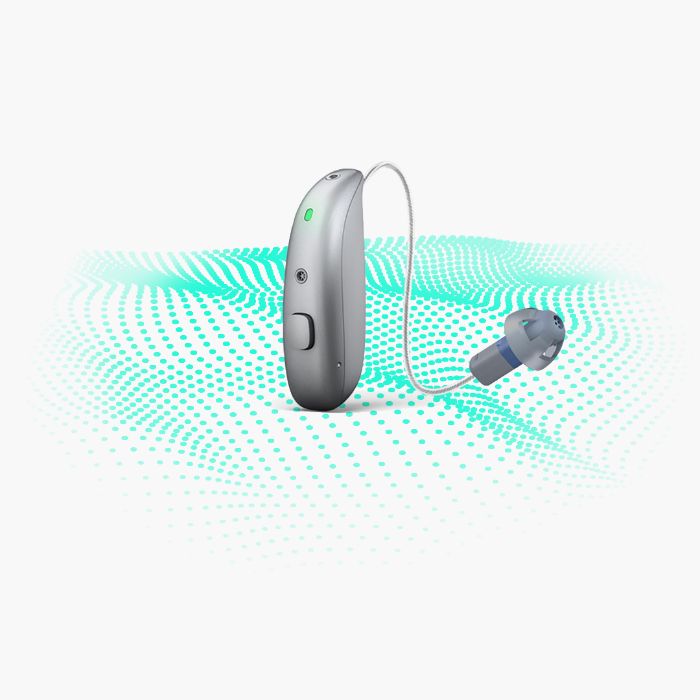
  • Volume and directionality
  • Background noise filtering
  • Speech enhancement based on your habits and preferences
  • They can even detect falls and track cognitive health in some models.
AI hearing aid at Amplifon

Experience a new generation of personalised hearing with Ampli mini AI

Amplifon's advanced artificial intelligence technology. From real-time sound adjustments to smart environmental detection, Ampli mini AI learns how you hear and adapts to your lifestyle.

Learn more

How do hearing aids work with tinnitus?

Many people wonder: how do hearing aids work with tinnitus?

Modern devices can:

  • Amplify external sounds, reducing the contrast of tinnitus
  • Include built-in sound therapy (e.g., white noise, nature sounds)
  • Help reduce stress and focus on external sound cues
  • This often leads to improved concentration and reduced awareness of tinnitus over time.

How do hearing aids work for the deaf?

How do hearing aids work for the deaf depends on the level of hearing loss. For individuals with profound hearing loss, traditional hearing aids may not be enough, and cochlear implants may be recommended.

However, for people with residual hearing, powerful hearing aids can amplify remaining sounds and improve communication, especially when paired with lip reading or captioning tools.

Visit your local clinic for more information

How do bluetooth hearing aids work?

Bluetooth hearing aids connect wirelessly to smartphones, TVs, and other devices. But how do Bluetooth hearing aids work?

They use low-energy Bluetooth technology to:

  • Stream phone calls and music directly to your hearing aids
  • Let you adjust settings via a mobile app
  • Connect to multiple devices simultaneously

This gives you better control and clarity in everyday situations.

How do you test if a hearing aid is working?

If you're unsure whether your device is functioning properly, how do you test if a hearing aid is working?

Try the following:

  • Ensure that wax or debris is not blocking the sound outlet
  • Ensure that any wax filter is clear and hearing aid tubes are not occluded with wax
  • Brush over the microphones to ensure dust or debris is not blocking it as it can reduce sound clarity
  • Insert the hearing aid correctly and check for sound
  • Try adjusting the volume or programme
  • Use a listening tube if you’re a carer or audiologist
  • Perform a battery test or recharge

If in doubt, book an appointment with a hearing care professional.

At Amplifon, we offer free hearing aid checks and servicing across all our Australian clinics.

Hearing aids to suit your needs

At Amplifon, you'll find hearing solutions that range from almost invisible styles that fit discreetly inside the ear, to those that sit snugly behind the ear. You can even select devices that connect wirelessly to your smartphone.

Discover more
People smiling and hugging each other

Need help with your hearing aids?

Whether you're curious about how hearing aids work, or you're having trouble with your device, Amplifon audiologists are here to help.

🔹 Book a free hearing aid consultation at your nearest Amplifon clinic

🔹 Try our hearing aid styles with no obligation

🔹 Get expert support and personalised fittings
a woman looking at herself through a mirror

We're here to help.

We take the time to understand your hearing health and the impact it’s having on your life and the people closest to you. With more than 350 Amplifon clincs we can ensure that we can support you when you need us most. Whether you need a FREE hearing test, or a hearing aid adjustment, our audiologists will provide you with expert, professional advice.

Discover all the benefits of Amplifon hearing aids

Ampli-Energy Rechargeable Hearing Aids
Rechargeable
ampli-connect headphones
Connected
Ampli-mini invisible hearing aids
Invisible
For everyone

Thank you

You will be contacted shortly by our team to book your appointment

Have a look at our related contents

Learn more on how your hearing works, thanks to our experts contents. You can also have a look at our blog, with our lates news. 

Get support and advice

Request an appointment

Book now

Take an online hearing test

Take the test

Find a clinic near you

Find a clinic