The theme for this years Dementia Action Week is that it's time to talk about dementia. In order to avoid situations where diagnosis is delayed, carers feel isolated or people can't find the help they need, we're encouraged to start conversations about dementia now.
This Dementia Action Week, running from the 21st to 27th of Septmber 2026, there’s also an important reason to put hearing health in the spotlight. New World Health Organization guidelines are adding to our understanding of the link between hearing loss and cognitive health, and why taking care of our hearing can be an important part of healthy ageing.
Every September, Dementia Action Week encourages Australians to learn more about dementia, challenge misconceptions and provide support for those affected by it.
For Amplifon, it’s also a timely opportunity to talk about something that can sometimes be overlooked when we think about our health as we age: our hearing.
We know that hearing helps us do much more than follow a conversation. It helps us stay socially engaged, participate in the activities we enjoy and feel connected to the people and world around us.
Now, growing research is also helping us better understand the relationship between hearing loss and cognitive health.
Dementia is complex. There is no single cause, and many different factors can influence a person’s risk throughout life.
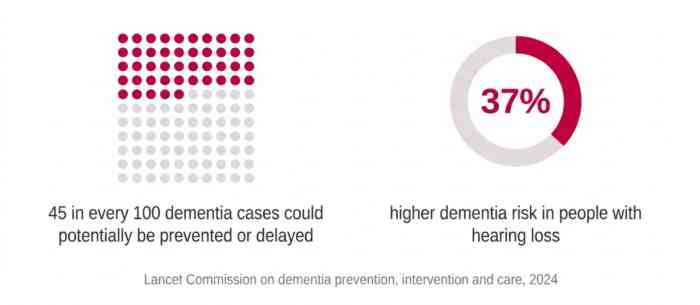
While there are many things that may contribute or influence someone's susceptibility to Dementia, recent research has identified hearing loss as one of several potentially modifiable risk factors associated with dementia. [1] The 2024 Lancet Commission found a 37% higher dementia risk in people with hearing loss. This doesn’t mean that hearing loss causes dementia, or that someone with hearing loss will develop it. What it does mean is that looking after our hearing deserves attention as part of looking after our overall health and wellbeing as we age.
Lancet Commission on dementia prevention, intervention and care, 2024
There are several possible explanations for the association. When hearing becomes more difficult, following conversations can require greater effort. Hearing loss may also make it harder for some people to participate in social situations and stay engaged with the people and activities they enjoy.
Research into these connections is continuing, but the evidence is significant enough that hearing has now been given greater attention in international guidance on dementia risk reduction.
[1] Livingston G et al., Dementia prevention, intervention, and care: 2024 report of the Lancet Commission, The Lancet (2024)

Discover suggestions on how to talk about hearing loss to someone who is affected by it.
Further to the Lancet Commision findings, in 2026 the World Health Organization (WHO) updated its guidelines on reducing the risk of cognitive decline and dementia.
For adults with hearing loss, the WHO now conditionally recommends that hearing aids may be offered to adults with hearing los to reduce the risk of cognitive decline and/or dementia.
Evidence reviewed for the updated guidelines found that hearing aid use may be associated with a reduced risk of dementia and mild cognitive impairment in adults with normal cognition. The effects of hearing aid use ranged from 17% to 27% lower risk of cognitive decline or dementia.[2]
It’s encouraging to hear that something within our control could have such an impact. It's also important to understand that this is described by the WHO as a conditional recommendation only, as the certainty of the evidence is still considered low. Hearing aids are not a way to prevent dementia, and they should not be used for that purpose alone. Instead, the new guidance reinforces a provisional message: identifying and addressing hearing loss matters, not only for hearing, but as part of supporting our overall health and quality of life as we age.
[2] WHO, Risk reduction of cognitive decline and dementia: WHO guidelines, second edition (updated 15 July 2026)
 Find your nearest Amplifon clinic
Find a clinic
Find your nearest Amplifon clinic
Find a clinic
At Amplifon, we see every day how much hearing can shape the way people experience life.
It’s being able to follow the conversation around the dinner table. Hearing a grandchild tell you about their day. Enjoying a favourite television program without constantly adjusting the volume. Feeling confident joining friends in a busy café.
These everyday moments are also why taking care of our hearing matters.
And because hearing loss often develops gradually, it can be easy to adapt without realising something has changed. You might start turning up the television. Busy environments may become more difficult. You may ask people to repeat themselves more often, or feel as though everyone around you has started mumbling.
Recognising these signs, and doing something about them, can be an important first step.
Dementia Action Week reminds us of the importance of talking openly about dementia and learning more about the ways we can support our health as we grow older.
There’s no single action that can prevent dementia, and many of its risk factors cannot be changed. But as our understanding of potentially modifiable risk factors continues to grow, the latest WHO guidance is another reminder that looking after our hearing shouldn’t be something we put off.
And taking the first step is as simple as taking a hearing test.
Just like having your eyes or teeth checked, making hearing checks part of your regular health routine can help you understand how your hearing is changing over time.
At Amplifon, our hearing care professionals can check your hearing, explain your results and, if hearing loss is identified, help you understand the options available to you.
Because hearing well is about more than hearing sounds clearly. It’s about staying involved, staying connected and continuing to enjoy the moments that make everyday life meaningful.
This Dementia Action Week, take a moment to think about your hearing too.
Book a free hearing check at your local Amplifon clinic and take a simple step towards looking after your hearing and overall wellbeing.


.jpg/jcr:content/renditions/cq5dam.web.700.700.jpeg)