

Over 350 clinics nationwide with prime locations open 7 days a week. Find your closest clinic

Middle ear anatomy

The middle ear is a vital part of the auditory system, playing a central role in how we perceive sound. Understanding its structure and the conditions that can affect it is key to maintaining good ear health and preventing long-term hearing problems. In this guide, we will explore the middle ear anatomy, its functions, the bones that enable sound transmission, and the most common issues such as middle ear infection, fluid build-up, and dysfunctions.

The anatomy of the Middle Ear explained

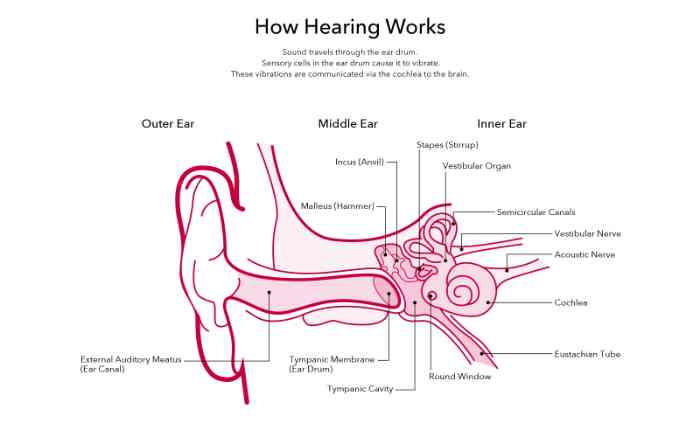
The anatomy of the middle ear is both intricate and fascinating. This small cavity plays a crucial role in hearing, acting as the link between the outer ear and the inner ear. The middle ear consists of the tympanic membrane, the tympanic cavity, the auditory ossicles, the mastoid wall and the auditory (Eustachian) tube.

Tympanic Membrane (Eardrum)

The tympanic membrane closes off the external auditory canal, separating it from the tympanic cavity. It has two surfaces: one facing the external ear canal, and the other facing the tympanic cavity, where it connects directly with the malleus (hammer). Thanks to its network of fibres, the tympanic membrane vibrates in response to sound waves. These vibrations are transmitted to the ossicle chain, enabling hearing.

Tympanic Cavity (Eardrum Case)

The tympanic cavity is a small, air-filled space between the outer and inner ear. It houses the ossicles and connects to the pharynx through the Eustachian tube, as well as to the mastoid through the aditus ad antrum. Under normal conditions, this cavity contains air, ventilated by the proper functioning of the Eustachian tube, which opens during actions such as swallowing, chewing, yawning or sneezing.

Ossicles of the Middle Ear

The auditory ossicles form a chain of three tiny bones – the malleus (hammer), incus (anvil) and stapes (stirrup). The malleus is anchored to the tympanic membrane, the incus acts as a bridge, and the stapes fits into the oval window of the cochlea. Together, they transmit and amplify vibrations from the eardrum to the inner ear.

Mastoid Cavity

The mastoid cavity, or mastoid, is formed by spongy bone tissue containing small air-filled cells, the largest being the tympanic antrum. This area is closely connected with the tympanic cavity and contributes to the overall ventilation and health of the middle ear.

Auditory (Eustachian) Tube

The auditory tube, also known as the Eustachian tube, is a 35–45 mm long canal linking the anterior wall of the tympanic cavity to the nasopharynx. Its role is to equalise air pressure in the middle ear, ensuring proper vibration of the tympanic membrane and ossicles.

Functions of the Middle Ear

The middle ear functions are essential for effective hearing. While its structure is small and delicate, its role in sound transmission and ear protection is fundamental.

Sound Transmission and Amplification

The main function of the middle ear is to transmit sound from the outer ear to the inner ear. Vibrations captured by the tympanic membrane are passed to the ossicles – the malleus, incus and stapes – which act as a lever system. This mechanism amplifies sound waves, ensuring that even very faint sounds can be heard.

Pressure Equalisation

Another key role is equalising air pressure between the middle ear and the external environment. The Eustachian tube regulates this balance, opening briefly during actions such as swallowing, chewing or yawning. This prevents damage to the tympanic membrane and helps maintain normal hearing.

Protection of the Inner Ear

The middle ear also provides protection against loud noises. The tiny muscles within the cavity, the tensor tympani and stapedius, contract reflexively when sounds are too intense. This reduces the force of vibrations, shielding the delicate inner ear structures from potential harm.
senior group of friends doing yoga outdoors

Book a free hearing test today

Take the first step towards better hearing health. Book an appointment with one of our qualified audiologists and receive personalised care tailored to your needs.

Middle Ear Infections

One of the most common conditions affecting this part of the ear is a middle ear infection. These infections often occur when bacteria or viruses enter through the Eustachian tube, usually following a cold or respiratory illness.

Middle Ear Infection Symptoms

Typical middle ear infection symptoms include:

  • Ear pain or discomfort
  • Difficulty hearing
  • Fluid drainage
  • A feeling of fullness in the ear
  • Fever in some cases

Children are particularly prone to ear infections, but adults can also experience them.

Middle Ear Infection Treatment

Most cases improve naturally, but middle ear infection treatment may involve antibiotics, pain relievers, or ear drops prescribed by a healthcare professional. If left untreated, infections can lead to more serious complications.

When discomfort strikes, many people search for ways to relieve middle ear pain. Over-the-counter painkillers, warm compresses, and rest may help, but persistent or severe pain always warrants medical attention.

Take our quick and easy online test and get instant results. Take the test now

Middle Ear Dysfunction and Rare Conditions

Middle ear dysfunction refers to a variety of problems where the ear fails to transmit sound efficiently. This may be due to chronic infections, Eustachian tube issues, or damage to the ossicles.

Myoclonus of the Middle Ear

Although rare, myoclonus of the middle ear is a condition in which the tiny muscles inside the ear spasm involuntarily. This can result in rhythmic clicking or buzzing sounds, often mistaken for tinnitus

Diseases of the Middle Ear

Other diseases of the middle ear include cholesteatoma (an abnormal skin growth), otosclerosis (bone overgrowth), and chronic otitis media. These conditions may lead to long-term hearing loss if not properly treated.

Fluid and Blockages in the Middle Ear

Fluid in the middle ear is another common issue, often linked to infections or allergies. This condition may cause muffled hearing or a sense of pressure.

People sometimes try to drain fluid from the middle ear at home, with remedies such as steam inhalation or gentle swallowing exercises. While home remedies may provide temporary relief, it is always best to seek medical advice. In certain cases, surgical procedures like grommet insertion may be required.

  • Important: Attempting to remove fluid using cotton buds, suction devices or any invasive method at home can be dangerous and should be avoided.
  • If fluid remains for more than a few weeks or causes pain and hearing difficulties, seeking medical care is strongly advised.

Blockage in the Middle Ear

A blockage in the middle ear can be caused by swollen tissues, infections, or dysfunction of the Eustachian tube. Persistent blockage should never be ignored, as it can impact hearing quality and balance.
Find your nearest clinic and speak to our experts today. Visit us at your local clinic

Diagram of the Middle Ear

A diagram of the middle ear can be useful for visualising its complex structure. Seeing how the eardrum, ossicles, and Eustachian tube interact helps to understand why infections or fluid build-up can cause so much discomfort.

Have a look at our related contents

Learn more on how your hearing works, thanks to our experts contents. You can also have a look at our blog, with our lates news. 

Get support and advice

Request an appointment

Book now

Take an online hearing test

Take the test

Find a clinic near you

Find a clinic