

Children’s Hearing Aids

How to choose the best hearing aid for infants.

Children’s Hearing Aids: A guide for parents

Hearing plays a crucial role in a child’s language development, social skills and learning. If your child has been diagnosed with hearing loss, choosing the right hearing solution can make a world of difference. This guide will help you understand the different types of children’s hearing aids, and how they can support your child’s growth and wellbeing.


*Please note that Amplifon UK does not sell or provide hearing aids for children. This article is intended for informational purposes only.

What are Children’s Hearing Aids?

Children’s hearing aids are small electronic devices designed to amplify sound and improve hearing in babies, toddlers, and children with hearing loss. They are adapted to be safe, durable and comfortable for smaller ears, and they come in various styles depending on the age, hearing needs and lifestyle of the child.

Key features of hearing aids for children

  • Volume control limiters to protect young ears
  • Tamper-proof battery doors
  • Bright colours or decorative options for personalisation
  • Robust casing to resist moisture and impact
close-up of a girl at the cinema.

Why choose Amplifon?

By choosing Amplifon as your hearing care provider, you’re choosing to be cared and looked after by qualified and experienced Audiologists who can help change the way you listen to the world around you.

Models of Hearing Aids for Children

Behind-The-Ear (BTE) Hearing Aids

Behind-The-Ear (BTE) hearing aids are the most common choice for children of all ages. They consist of a small device that sits behind the ear and connects to a custom-made ear mould inside the ear canal.

Why BTE are ideal for children:

  • Durable and resistant to moisture and impact
  • Easy to handle and clean
  • Suitable for all types and degrees of hearing loss
  • Flexible for growing ears: the ear mould can be replaced as the child grows
  • Safety features like tamper-proof battery compartments

Receiver-In-Canal (RIC) Hearing Aids

Receiver-In-Canal (RIC) models are smaller and more discreet than BTE devices, with the receiver (speaker) placed directly inside the ear canal.

Considerations for kids:

  • Often recommended for older children with mild to moderate hearing loss
  • Lightweight and comfortable
  • Can offer advanced features like wireless connectivity
  • Less robust than BTE, so may not be ideal for very young children

Bone Conduction Hearing Aids

Bone conduction aids are a special type of hearing device used when traditional hearing aids aren’t suitable, such as in cases of conductive hearing loss or when the ear canal cannot be used.

How they work:

  • Transmit sound vibrations through the bones of the skull directly to the inner ear
  • Can be worn with a headband or surgically implanted (BAHA)
  • Suitable for children with conditions like atresia or chronic ear infections

The importance of regular check-ups

It is always important to check our hearing and not to underestimate the first signals our body gives us. This is why we invite you to visit the amplifon centre near you so that you can talk to specialists and undergo the various tests.

Book an appointment

Children’s hearing aids for glue ear

Glue ear is a temporary condition where fluid builds up behind the eardrum, often after colds or infections. It’s very common in children and may resolve on its own — but if it persists, children’s hearing aids for glue ear can be a safe and non-invasive solution.

How hearing aids can help:

  • Improve clarity of speech in noisy environments
  • Prevent delays in learning and communication
  • Avoid the need for surgery (e.g. grommet insertion)
  • Your audiologist may recommend a short-term use of hearing aids during the course of the condition.

Benefits of hearing aids for children

There are many advantages to early and consistent hearing aid use in children. Some of the most important include:

  • Better speech and language development
  • Stronger academic performance
  • Enhanced social skills and confidence
  • Improved parent-child communication
  • Easier integration at school and in group activities

Children who grow up using hearing aids often see them as a normal part of life and may even enjoy choosing their own colours or styles.

Supporting your child with hearing loss

As a parent, it’s natural to have questions and concerns. The good news is that modern children’s hearing aids are comfortable, effective, and supported by a full care team.

What to expect from your hearing care provider:

  • Personalised fitting by a paediatric audiologist
  • Ongoing aftercare and check-ups
  • Guidance for school environments
  • Training on device use and maintenance

Curious about your child’s hearing?

Take our quick and easy online hearing test from home to get an initial assessment.

Take the test now
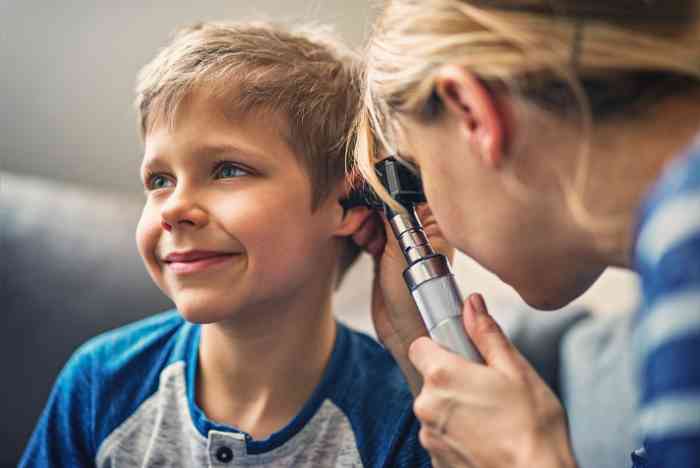
audiologist performing otoscopy on a smiling boy.

Buying hearing aids for children

Choosing where to buy a hearing aid for your child should be a well-informed and thoughtful decision. As we've seen, the more tailored the device is to the child who will be wearing it, the better the outcome will be.

While hearing aids may be available at some pharmacies or through NHS services, it is generally recommended to seek advice from a paediatric audiology specialist.

*Please note that Amplifon UK does not sell or provide hearing aids for children. This article is intended for informational purposes only.

Does my child need a hearing aid?

Hearing loss can occur at any stage of a child’s life, and the signs may vary depending on their age.

If your child is under one year old, you may notice they don’t respond appropriately to voices or environmental sounds, or they may show delays in early vocal development (such as babbling).

Between the ages of two and five, signs can include delayed or insufficient speech development. For school-age children, difficulties with academic performance may be a sign of hearing issues.

If you suspect your child may have a hearing problem, the first step is to speak to your GP or paediatrician, who can refer you to an ENT specialist (Ear, Nose and Throat doctor) for further evaluation and the most suitable treatment path.

Helpful Tips for Parents

Dear parents, rest assured — with their new hearing aids, your child will be able to enjoy everyday life just like any other child. Below are a few helpful suggestions to support them as they adjust to this important change with confidence and peace of mind.

Helping Your Child Use Their Hearing Aids

Take time to familiarise your child with their hearing aids. Use positive reinforcement and make them feel comfortable wearing the devices in daily routines.

Caring for Hearing Aids

Teach your child the basics of hearing aid maintenance as they grow older, and make sure devices are cleaned and checked regularly to ensure the best performance.

Hearing Aids and School Life

Work with teachers and school staff to make sure your child’s hearing needs are supported in the classroom. Many modern hearing aids offer wireless technology to connect with school devices or microphones.

Hearing Aids and Sports

Most hearing aids are built to be durable and can handle day-to-day physical activity. For sports or outdoor play, consider accessories like retention clips or sweat covers for added protection.

Curious about your child’s hearing?

Take our quick and easy online hearing test from home to get an initial assessment.

Book an appointment

FAQs on children’s hearing aids

Are hearing aids suitable for very young children?

Yes. Babies can be fitted with hearing aids within the first months of life if needed. Early treatment is crucial for speech and cognitive development.

Do all children with glue ear need hearing aids?

Not always. Glue ear often clears up naturally. However, hearing aids may be recommended if it persists and causes learning or speech issues.

Are hearing aids for children covered by the NHS?

Yes. The NHS provides hearing tests, fittings and paediatric hearing aids free of charge.
Find your nearest clinic in one click

Have a look at out related contents

Learn more on how your hearing works, thanks to our experts contents. You can also have a look at our blog, with our lates news. 

Get support and advice

Book a free hearing test

Book now

Test your hearing online

Take the test

Find your nearest store

Find a store