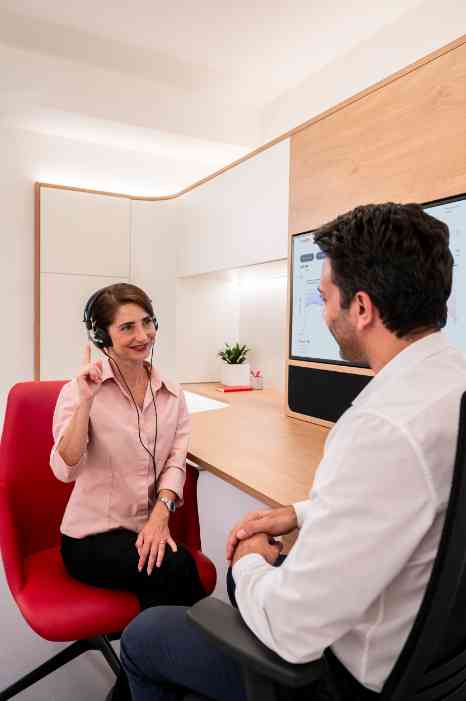


The test is safe, comfortable and non-invasive, and it usually takes approximately 15–30 minutes.
You will listen to a series of tones through headphones or earphones and respond whenever you hear a sound—even if it is very soft.
Each ear is assessed separately across a range of pitches. If required, a small vibrating device may also be placed behind your ear to help determine how sound is reaching the inner ear.
|
|
|---|---|
Duration |
Usually 15–30 minutes |
Environment |
A quiet, controlled testing space |
Sensation |
Comfortable and painless |
Your task |
Respond each time you hear a tone |
Suitable for |
Adults and children able to respond reliably |
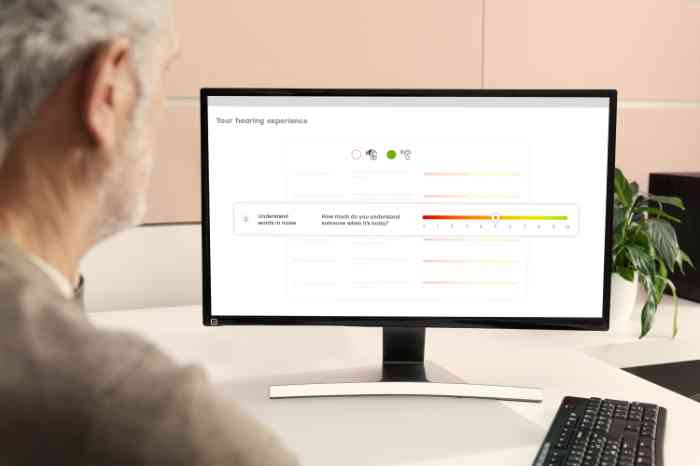
Your results are recorded on a graph called an audiogram. It shows the quietest sounds you can hear at different frequencies in each ear.
Your audiologist will explain the results in clear, practical terms and may combine them with:
Pure-tone audiometry can detect hearing changes associated with:
An audiogram provides valuable information about hearing sensitivity, but it does not always explain the cause of a hearing loss or how well someone understands speech in everyday situations—particularly in background noise.
For this reason, pure-tone audiometry is most valuable when it forms part of a comprehensive hearing assessment performed and interpreted by a qualified hearing professional.
If you notice your hearing deteriorating, it's best to undergo a hearing test.
Thanks to sound and speech audiometry tests, hearing care professionals can determine a person's hearing health, identify hearing impairments and suggest the appropriate solution in the next step.
 Find your nearest clinic in one click
Learn more on how your hearing works, thanks to our experts contents. You can also have a look at our blog, with our lates news.